

If you missed the final night of the second round of women’s March Madness, you missed a great night of television.
The games of the night were UConn (2-seed) surviving a poor shooting night to win 52-47 against UCF (7-seed), and Tennessee (4-seed) escaping Belmont’s (12-seed) second half run to win 70-67.
Uconn and Tennessee are the two most successful programs in women’s college basketball and both were given a back-to-the-wall challenge against mid-major programs.
The Uconn and UCF game, which was held at Uconn’s Harry A. Gampel Pavilion, sold out. ESPN PR reported that the game was watched by 1.13 million people. Stars sell, and even though Paige Bueckers is still working back from injury and not her full self, she does move the needle. The same goes for Iowa’s Caitlan Clark, her viral threes from deep range has made her a star. The Hawkeyes lost in the second round, but ESPN noted that their second-round game on ABC rated 993k viewers.
A factor that has aided both the men’s and women’s tournament numbers from last season has been the return of fans at the game. Whether it was the NBA Bubble or last year’s March Madness tournament have seen a pattern of television rating being down when there were no or limited fans in the arena. T
he atmosphere Monday at UConn was electric. It added to the game and gave us that member able photo that is used as this stories header. A great crowd adds to the viewing experience at home.
Glancing at the bracket there seems to be more volatility or “madness” than a normal season. A common critique of the women’s tournament is that it is too predictable
As Twitter is designed to do, this Tweet caused a lot of angry back-and-forths about the entertainment value of women’s basketball.
No one has to like the women’s tournament. I am a fan, but bullying people like Darren Rovell to also say positive things about it is not a good way to gain new fans. We should focus on highlighting the games, not the societal discussion around it.
Having said that, it is odd sometimes to see people who are not fans talk so much about how they do not like it. Even though I am not a hockey fan, I don’t comment on hockey posts insulting the game, I just scroll past it. It is probably a you problem if they feel the need to voice their complaints about the game. Like whatever, just don’t watch.
The Breanna Stewart-era dominance of UConn has a lot to do with this perception. When Brianna Stewart played in 2012-2016, Uconn went 151-5, winning all four titles. They cruised to each title, never even given a scare. In the four championship games, they won by an average score of 23.8 points. In the last two seasons, the team won by an average score of 40 points for the season, which was partly an outcome of playing in the Big East.
After Stewart graduated, she left other women’s programs with a hope of being the last team standing. There have been four unique champions, and none of them are UConn. The outcome of three out of the last four championship games have been decided by one score.
Granted, the champions have all been one seeds. It’s a rarity to see anything below a two seed make it to the final four. The results are more predictable than the men’s tournament. There is a reason why some of my women’s Final Four is still alive in my bracket. The talent gap is still great between the premiere teams and everyone else.
However, the first two rounds of games showed more competitive games early on.
I developed an imperfect way to measure parity levels in the sweet 16. I added all the seeds remaining for each of the past 20 seasons. The minimum possible score would be 40, if all remaining seeds are 1,2,3,4. (1+2+3+4) * 4. I am calling this the cumulative seed. The lower the cumulative seed, the more chalk that tournament was.
It was the hope that there would be some identifiable trend to comment on how women’s basketball has had more “madness” over the past 20 years. However as the chart shows, it really just depends on the year. Some years the tournament was extreme chalk. The average of the 20 years was a cumulative seed of The cumulative seed this year was higher than the average (57.3), but not significantly, despite the surprise upsets of two-seeds Baylor and Iowa. This year’s tournament was that average, but last year’s was below. There is no trend at all according to my method.

The men’s tournament has more high seeds in the Sweet 16. The average cumulative seed over the past 20 tournaments was 71.75.
The numbers lay out what we know, that the men’s tournament has more underdogs going further.

The other thing to look at is the margin of victory in the games. A 40-point and a 30-point blowout is not much different to the viewer, you are switching the game either way. So let’s go by categories, nail-biters (games decided five points or less), Striking Distance (games decided by 6-12 points, Let’s Keep It On (games decided by 13-20 points), Not Watchable (games decided by 20 or more points). Final scores do not always capture how close the game was, but this is intended to get a rough idea of how close the games have been so far this season.
The women’s tournament has had a lot of blowouts, but a fair amount of nail biters.
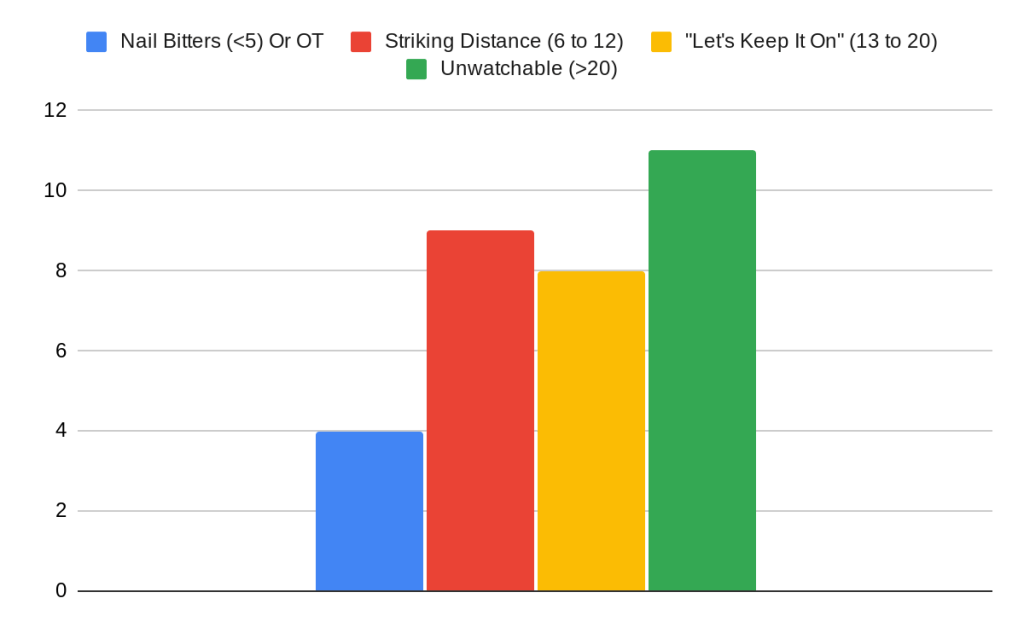
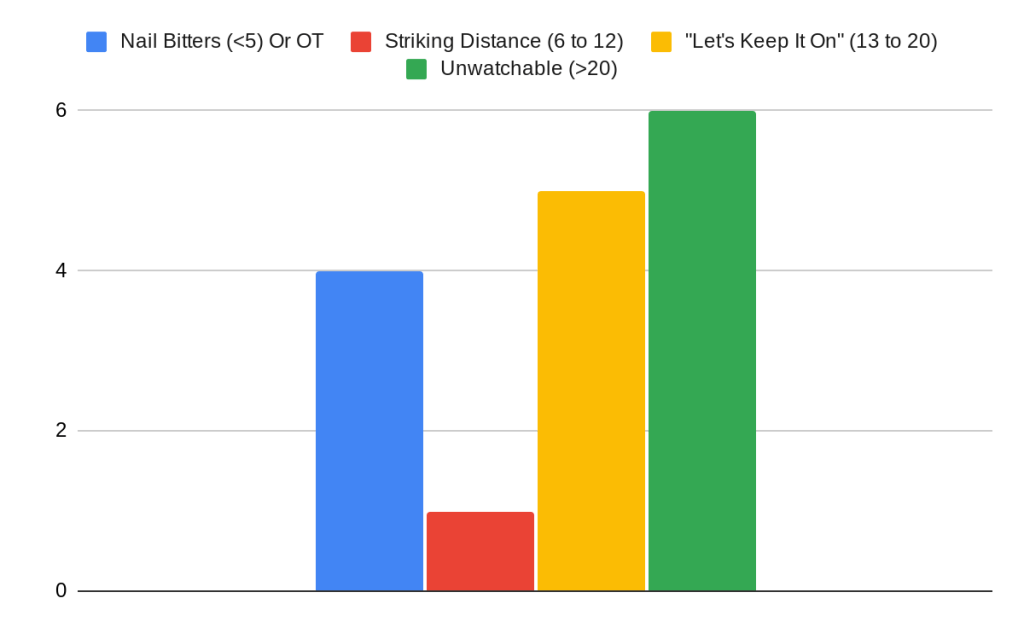
You will find that the rate is similar on the men’s side. There were a few great games, some games that are close enough to keep watching, and blowouts.
The women’s tournament picks back up Friday. It will be interesting to see if the top teams continue to find themselves in close games, and how the surviving double digit seeds fair going into the second week of play.
Header Photo Courtesy of University of Connecticut Athletics
 The Efficient Shot