
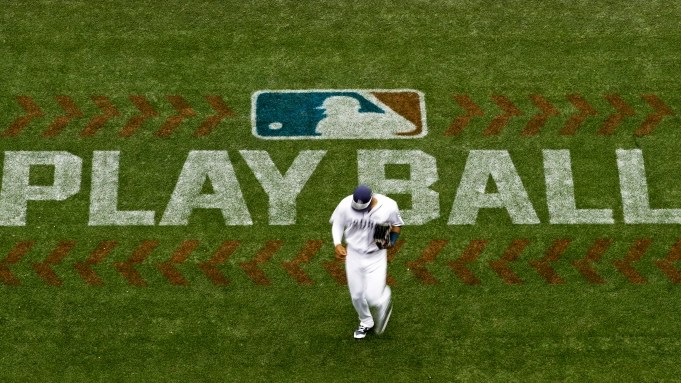
After 99 days of a lockout, back and forth posturing and media maneuvering, and countless stock photos of bases wrapped in chainlinks, Major League Baseball is back up and running.
The two sides agreed to a new collective bargaining agreement Thursday afternoon that will last for the next five seasons.
Under the new deal, the Competitive Balance will start at $230 million in 2023, which is an increase from $210 million last season. The minimum salary, which was $580,000, will jump to $700,000 next season. The league will implement a $50 million pre-arbitration bonus pool.
The baseball postseason will now have 12-teams. The top two division winners will get a first round bye. The last place among the division winners and the three wild card teams play in a best-of-three first round.
New rules that were previously reported became official, including a universal designated hitter, and the elimination of the pandemic rules of an automatic runner at second in extra innings and 7-inning double-header games.
The owner’s unanimously approved the proposal. The eight player executive committee unanimously voted against the deal. However, the player reps voted to approve the deal by a 26-4 count, reaching the simple majority needed.
As the Rolling Stone song goes, the player’s executive committee did not get what they wanted, but they got enough of what they needed.
We were also elected to try to put together the best CBA that we could,” Zac Britton told The Athletic about the unanimous no vote “Our guys felt that we had accomplished a lot — maybe not everything we wanted, but a lot — and were ready to play. The union has never been more unified or informed during my time in the league than it has been over the last year or two.
Even though most of the executive committee are high-earning veterans, many repped by megadeal agent Scott Boras, they had a lot of victories for the average player.
The pre-arbitration bonus are for players with less than three full years of service time and have yet to enter the arbitration portion of their career. According to Travis Sawchik from The Score, 63.2% of all players that stepped on the in the 2019 had less than three years of service time. That group of players accounted for 53.6% of players but less than 9.8% of players pay. The Union needed to cut into that discrepancy. While they will still be a bargain for teams, pre-arbitration players will get a bigger piece of the pie than 9.8% because of this pool.
Fighting for a higher minimum salary and even distributed pool is meaningful to the average player. Sawchik mentioned that the average career for a baseball span for a major league player is around 3.71 years of service time. Many of the 1,200 players that voted in via their players representative will not arbitration. The movement with both the minimum salary and the arbitration pool were likely why this deal was good enough to accept for the average player.
The CBA . No pitch clocks, no shift bans, no major systemic changes to make the game better.
The designated hitter being in only one league for almost 50 years is going to be a hard thing to explain to the next generation of baseball fans. “You see Tyler, the American League had a DH. Now the National League instead had the pitcher hit. And they were terrible. They would mostly just hope to make contact.”
The runner on second rule had its advantages. It incorporated some new strategy to the game and it avoided the three hour games from extending much longer than that. It was understandably polarizing. The extra-inning games that go far into the night were less frequent by this rule.
Even though some players feel like they may have left some stuff on the table, it is hard to know what could have been gained by pushing this lockout even further. The owner’s will always have the upper hand. They would be hurt less from missed games than the players. The owner’s may have moved a little more if they kept pushing, but it is hard to take that gamble especially with so many livelihoods on the line.
Labor negotiation are not fans favorite topics to hear and read about, but it was necessary to get through this for more equitable for the players. Profits for Major League Baseball had increased while players salaries went down. That needed to be rectified and this agreement was a step to make that better.
 The Efficient Shot