

The lockout started 90 days ago. That is a nice runway to avoid what happened this week.
Much like how I would handle a big school project that was due at the end of the quarter, the start of this big negotiations started too late. The negotiations started five weeks after the lockout began. Even as a person that understands more than anything the desire to procrastinate large tasks, at least get some of the easier stuff off your plate.
Late Monday going into Tuesday, both sides were scrambling to close the gaps on the competitive balance tax, minimum salaries, and arbitration rules. After a day of speculation of how close the deal was, Rob Manfred announced Tuesday evening that a deal had not been reached, resulting in the owner’s canceling the first two series of the season.
Deadlines sometimes create action, but not here. The owners submitted a “final and best offer” on Tuesday, but the offer was not much different from their previous one.
The player’s union unanimously rejected it.
The good news is that there is a crazy gulf between the sides like during the 1994 players strike. The two sides are negotiating about money, they are not debating structural changes. The money difference is not far apart, especially for the 32 billionaires. A $250k gap between to the two side on what the minimum contract should be seems solvable.
The other major sticking point seem is the competitive balance tax (CBT). The tax has worked like a de facto salary cap. Last season, the competitive balance tax line was set at $210 million. If you go over the amount you are taxed for every dollar over. The percentage of the tax increases depending on how over the team is and how many consecutive years they have gone over the CBT. Even the biggest market work to stay under the line. The Dodgers and Padres were the only teams in 2021 that paid the tax.
The owner’s side argues that the tax is to make things more fair between small and big market teams.
Many will hold up the Rays as the golden example for how you can win without a high payroll. The Rays are a remarkably run organization. Their recent success is not indicative of what it is like for most low-spending teams. A team with an above average payroll has a better chance at being good than a team with a below average one.
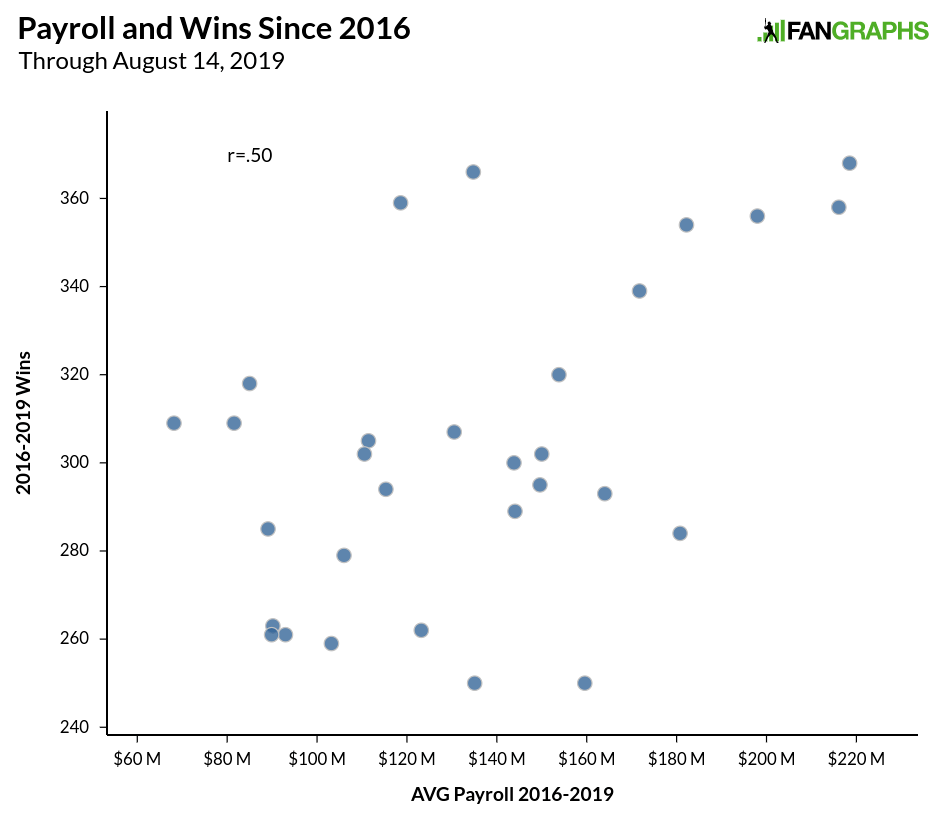
A correlation of r=.50 may not be as high as some would have thought, but there is undeniably a meaningful relationship between spending more on your team and winning. The question is how much would runaway spending impact the game competitive balance.
What baseball has going for it compared to other leagues is that its playoffs are very random.You get many different champions because the ‘better’ team on paper does not always win the series like in the NBA or even the win-or-go-home format of the NFL. That is just the way the game is designed. So even if the Mets, Yankees, and Dodgers are always winning the bidding wars on the top Scott Boras clients of the year, it is not foregone conclusion that they will win the title; It is different from what it felt like when the Golden State Warriors added Kevin Durant.
The player’s union is trying to get CBT as high as they can get it. The owners last proposal was $220 million or a 4.7 percent increase in the CBT. The valid point the player’s union has is that the profits are going to increase more than that because of the expanded playoff format. With fans and players, there is not a real appetite for expanded playoffs. No one is really clamoring for an 83-win team to makes the postseason. It is a rule that is agreed upon strictly for added money for the owners. So it makes sense the player’s should get something economically substantial back.
New York Posts Andrew Marchand reported that ESPN would pay $100 million for a 14-team format and $85 for a 12-team scenario. I do not fully trust most revenue projection that you may see on Forbes, but Marchand is very connected to the ESPN brass and these numbers seem right.
For all the talk about the game dying, baseball is a more profitable sport, both from in-game attendance and from regional television deals. Sunday Night Baseball is not breaking any ratings records, but regional network deals, and attendance for 2,430 games that are played in a (ordinary) regular season is major business.
Pre-arbitration pool money is another issue that the sides are far a part on. ESPN reported that the pool money would be distributed based on the top-30 WAR leaders that are in pre-arbitration, and extra money if they win an award like the MVP or Cy Young.
One of many examples who could have benefited from this system is Shane Bieber. Who through four seasons has made $2.1 million. He won a Cy-Young Award in the shortened 2020 season, and made the all-star team his another two full seasons. He has accumulated a 13.9 Wins Above Replacement (WAR) on Fangraphs for his career. Averaging out the value of 1 WAR in the past five free agencies, the market value has been $8.12 million/1 WAR. If you paid for past production, Bieber would be worth 112.86 million for his first four seasons. Free agency is a supply and demand involved, if every player was on the market after every season, the WAR value would be different. But my point is that players that have success early are under-paid and wait too long to get big money.
You do not need to be worried about Bieber’s ability to pay for his Netflix account, but you can understand why the union wants to get him something closer to his open-market value. Bieber will more than likely end up with a nice 9-digit contract when he hits free agency in 2025 when he is 30, but we have seen elite pitchers battle injuries and never be the same. From the union perspective, the pre-arbitration pool can help rectify this probably while still being reasonably priced for the team.
The player’s union has moved far more than the owner’s side and the owner’s side is starting out with the better end of the deal to begin with.
Much like the labor force as a whole, the union sees the revenue increase yearly, but the salaries stay, unless you are a star, stagnant. The minimum salary for an MLB has not gone up and the middle-class baseball player is being squeezed out of the because it is so much cheaper to bring someone from the minors up, who often is not as good.
Workers are realizing that they are more valuable than management wants them to know. So it might cause some inconvenience now for fans. If it takes a little time to get a more fair deal then we can miss some April baseball.
Header Photo Courtesy of The Associated Press
 The Efficient Shot